Golf shoes are worn for five hours, on uneven ground, while your foot is loaded sideways. That is a different job from a trainer, and it needs a different fit - snug at the heel and midfoot, with room at the toes.
Measure your foot properly, once
It takes two minutes and it will save you a return:
- Do it in the evening. Feet swell during the day, and you play golf in the afternoon, not at 7 am.
- Wear the socks you actually play in. A thick winter sock is a third of a size.
- Stand on a sheet of paper with your heel against a wall, weight on the foot, and mark the tip of the longest toe.
- Measure heel to mark in millimetres. Do both feet - most people have one that is 3-5 mm longer, and you buy for the larger one.
- That number is your foot length, and it is what you look up. Do not add anything to it: the 5-10 mm of toe room a golf shoe needs is already built into the tables below.
Conversion: men
| Measured foot length | UK | EU | US |
|---|---|---|---|
| 24.5 cm | 6 | 39.5 | 7 |
| 25.4 cm | 7 | 40.5 | 8 |
| 26.2 cm | 8 | 42 | 9 |
| 27.1 cm | 9 | 43 | 10 |
| 27.9 cm | 10 | 44.5 | 11 |
| 28.8 cm | 11 | 46 | 12 |
| 29.6 cm | 12 | 47 | 13 |
Conversion: ladies
| Measured foot length | UK | EU | US |
|---|---|---|---|
| 22.5 cm | 4 | 37 | 6 |
| 23.3 cm | 5 | 38 | 7 |
| 24.1 cm | 6 | 39.5 | 8 |
| 25.0 cm | 7 | 40.5 | 9 |
| 25.8 cm | 8 | 42 | 10 |
These are approximate, and if you fall between two rows, take the larger one. American brands quote US sizes, British brands quote UK, and half sizes do not land in the same place on every last, so always check the manufacturer's own chart on the product page before ordering.
Width is the spec people ignore
Length is only half of it. If the shoe is right on length but your foot spills over the sole edge, or your heel lifts on every backswing, you have a width problem rather than a size problem.
- Narrow (marked N, or 2A on some charts) - for a slim foot, or a foot that slides forward inside a standard shoe.
- Standard / medium (M or D) - the default that most models come in.
- Wide (W, E or EE) and extra wide (XW) - for a broad forefoot or a high instep.
Not every brand offers a width choice, and the ones that do usually offer it only on part of the range. FootJoy has historically been the most consistent about it. If you know you are wide-footed, filter for width first and then look at models - it saves a lot of time.
Going a half size up to get more width is the classic mistake. You end up with a shoe that is too long, the heel slips, and the foot moves during the swing, which is exactly what a golf shoe is meant to prevent.
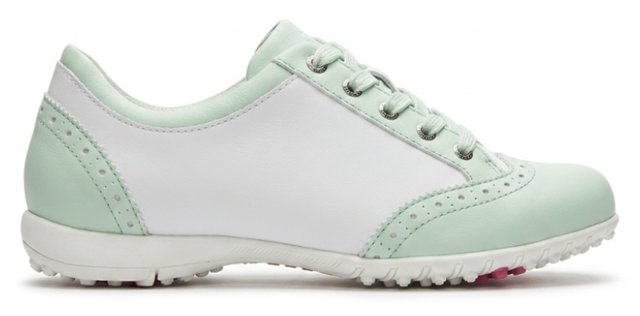
The fit test at home
- Put both shoes on with golf socks and lace them properly, not loosely.
- Stand up. You want roughly a thumbnail of space in front of the longest toe.
- Walk. The heel should not lift more than a couple of millimetres.
- Take a slow swing on the carpet. The foot should not roll over the edge of the sole.
- If any of that fails, do not talk yourself into it - unworn shoes go back easily, played-in ones do not.
Juniors
Buy on measured foot length, never on age, and re-measure every spring - juniors commonly go up one to one and a half sizes in a season. Half a size of growing room is sensible; a full size is not. A shoe that is two sizes too big destabilises the lower body, which is the one thing you do not want to teach a young swing.
What to take away
- Measure in the evening, in golf socks, and buy for the longer foot.
- Look up the measured length as it is - toe room is already in the table. Check the brand's own chart, not a generic one.
- If the fit is wrong across the foot, change the width, not the length.
- Juniors: measured length every spring, half a size of growing room at most.
Sizes and widths are listed on every product page in men's, ladies and junior golf shoes.