Wheel count is not a spec sheet detail. It decides how the trolley behaves on a side slope, how it turns, how flat it folds, and how much of your attention it takes up over four hours.
Three wheels: the default for a reason
One wheel at the front, two at the back. It turns on the spot, it tracks straight without you steering, and it copes with rough or wet ground better than anything else because the load sits over three contact points that can each find their own level.
The trade-off is a bit more length when folded, and a mild tendency to tip if you park it across a steep slope with a heavy bag and lean on the handle. That is the layout almost every serious push trolley uses, and almost every electric one too.
Four wheels: stability first
Four wheels stand up on their own on almost any lie, sit flatter under a heavy tour bag, and generally feel the most planted on a side slope. They are also the easiest to load and unload because they never want to roll away.
What you pay for it is weight, a bit more effort turning - four contact patches have to scrub round a corner - and usually a larger folded package. Some four-wheel designs use a swivelling front pair, which recovers most of the manoeuvrability.
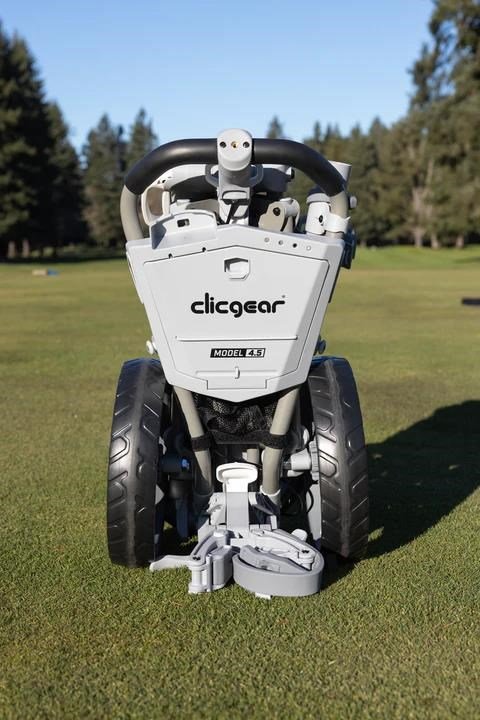
Two wheels: the pull trolley
The oldest design and still the lightest and cheapest. You pull it behind you rather than push it, which is harder on your shoulder and means you spend the round half-turned to check on it. It will not stand up on its own without a stand leg.
It still has a place: a spare in the boot, a trolley for a junior, or something to keep at a second course. As your only trolley it is a false economy - three wheels is simply less work.
Side by side
| 2 wheels (pull) | 3 wheels | 4 wheels | |
|---|---|---|---|
| Manoeuvrability | Poor - you are dragging it | Best | Good, better with a swivelling front pair |
| Stability on a slope | Low | Good | Highest |
| Weight | Lightest | Middle | Heaviest |
| Folded size | Smallest | Compact | Largest |
| Stands unaided | Only with a stand leg | Yes | Yes, anywhere |
The wheels themselves matter as much as the count
- Diameter. Bigger wheels roll over wet, rutted turf with less effort. Small wheels bog down in exactly the conditions where you would rather not be pushing.
- Tyre width and tread. Wide, lightly treaded tyres spread the load and mark greens surrounds less. Aggressive tread grips better on a wet slope but picks up more mud.
- Air or foam. Pneumatic tyres roll more softly and need occasional checking; solid foam or EVA never punctures and never needs a pump.
- Bearings and quick release. Sealed bearings survive being hosed down. Quick-release wheels come off in seconds, which is how a trolley fits into a small boot.
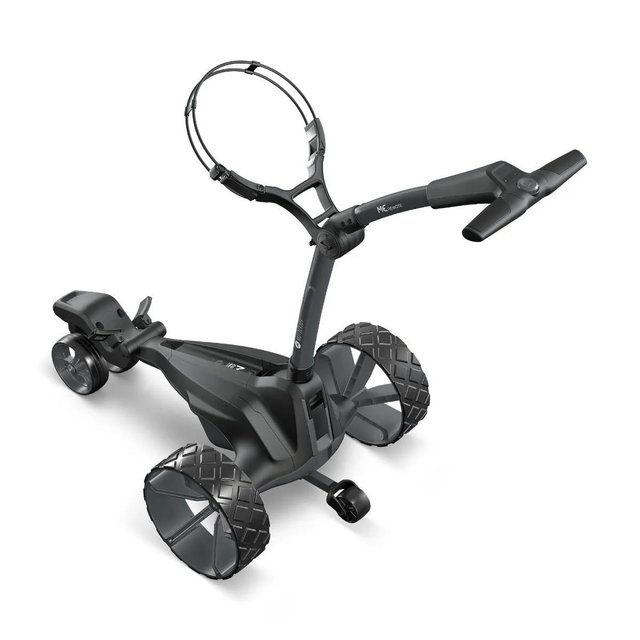
Electric trolleys: same question, different answer
Almost all electric trolleys are three-wheelers with two driven rear wheels and a free front wheel. The front wheel is what keeps it tracking straight, and on many models it can be locked or adjusted for a slight offset to compensate for camber.
On an electric trolley, tread is worth a second look for a different reason: on several Motocaddy and MGI models it is the quickest way to tell whether downhill control is fitted. Four-wheel electric trolleys do exist and are stable and heavy in equal measure - fine if the trolley lives in the club store, less fun if you lift it in and out of a car every week.
What to take away
- Three wheels is the right answer for most golfers on most courses.
- Four wheels for maximum stability under a heavy bag, at the cost of weight and fold size.
- Two wheels only as a second trolley or for a junior.
- Wheel size, tyre width and sealed bearings matter more than the count once you are past two.
Have a look through push and pull trolleys and electric trolleys.