The choice comes down to one honest question: do you carry, or does something else carry for you? Everything else - dividers, pockets, weight - follows from that answer.
Stand bag
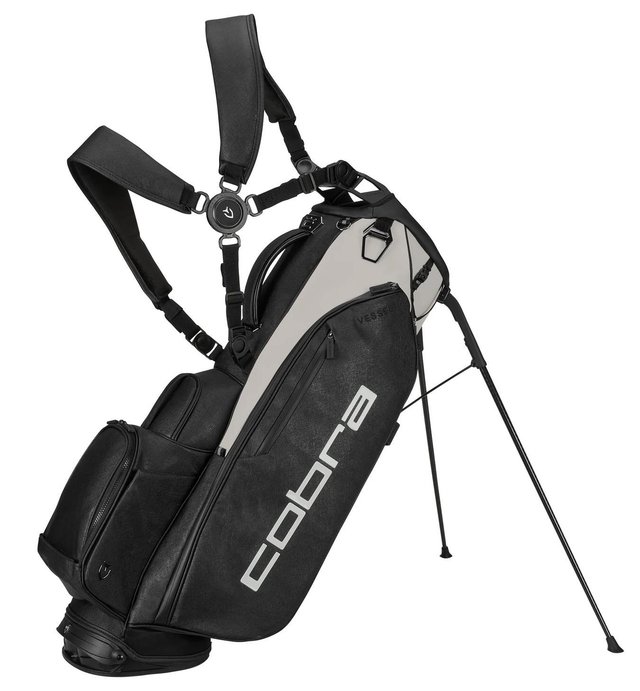
Legs, a dual strap and a body built to sit on your back. A modern stand bag weighs somewhere around 2-3 kg empty, has four to seven dividers, and one large pocket down the side you can reach while it is on your shoulder.
It is the more flexible of the two. Even players who use a trolley every round often keep a stand bag for the days they turn up to hit balls for an hour and cannot be bothered unfolding a trolley to walk fifty metres to the range. It is also the easier bag to fly with, because it takes up less room inside a travel cover.
Larger stand bags now exist that sit happily on a trolley too, so the old rule that a stand bag means carrying is not really true any more.
Cart bag
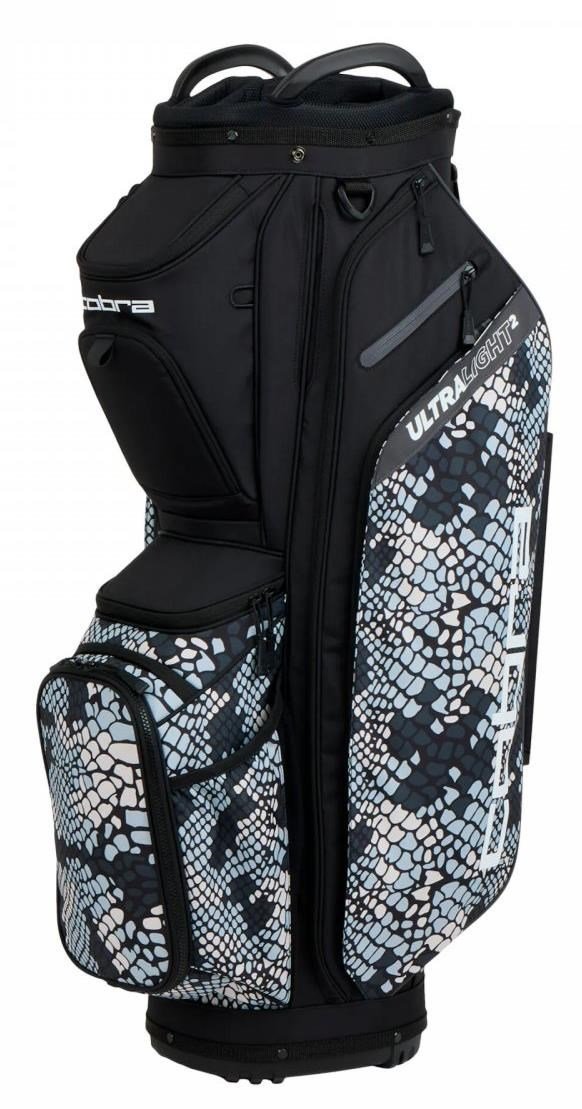
No legs, usually a single shoulder strap for moving it from car to trolley, and a base designed to lock onto a trolley or a buggy. Look around any car park and most bags are cart bags, simply because most club golfers now push or ride.
What you get in exchange for the legs is storage: large pockets on both sides instead of one, a full 14 or 15 divider top so every club has its own slot, and usually a cart-friendly back so the pockets stay reachable with the bag strapped down.
Pencil bag
The lightest thing you can own, around 1-1.5 kg, one or two dividers, carried over the shoulder or on your back like a small rucksack. It is for the range, for a quick nine with half a set, and for travelling when you want the smallest possible package. Most have no rigid base, so they lean rather than stand.
The comparison in one table
| Stand bag | Cart bag | Pencil bag | |
|---|---|---|---|
| Weight (empty) | ~2-3 kg | ~2.5-4 kg | ~1-1.5 kg |
| Dividers | 4-7, some 14 | 14-15 | 1-3 |
| Legs | Yes | No | Rarely |
| Big pockets | One side | Both sides | Minimal |
| Suits | Walking, mixed use, travel | Trolley or buggy every round | Range, quick nines, air travel |
Weight, dividers and storage
Weight only matters if you carry. New materials have brought some cart bags down close to 2 kg, so the old gap has narrowed considerably. At the other end, tour bags are enormous and heavy and make sense mainly if somebody else is moving them.
Dividers are pure preference. Fourteen individual slots keep the set tidy and stop shafts rattling and rubbing; fewer, larger openings are faster to work with and lighter. Neither one hits the ball.
Every bag holds balls, tees and a glove. The real difference is what else fits - a waterproof jacket, a jumper, lunch, a bottle and a training aid. That is where a cart bag's second full-length pocket earns its keep.
Waterproof bags
Fully waterproof bags have gone from a niche to a sensible default for anyone who plays through the season. The material is welded rather than stitched and the zips are taped, so when a shower arrives you zip the hood and carry on playing.
The other advantages are less obvious and arguably better: nothing to dry out afterwards, mud wipes straight off, and the fabric holds its colour far longer than a standard textile bag. They used to look like a rain cape with a zip - that is no longer the case.
What to take away
- Carry more than occasionally: stand bag. Trolley every round: cart bag.
- Dividers and pocket count are preference; weight only matters on your back.
- Check the base and strap slots against your own trolley before ordering.
- A waterproof body is worth it if you play in spring and autumn, not just July.
Browse stand bags, cart bags or the lightweight pencil bags.